India’s defence relationship with Russia is entering a more complicated phase.
For decades, Russian and Soviet-origin weapons have formed the backbone of large parts of the Indian Army’s armoured, mechanised and air-defence capabilities. At the same time, New Delhi has been steadily pushing for indigenous production and diversifying its sources of military equipment.
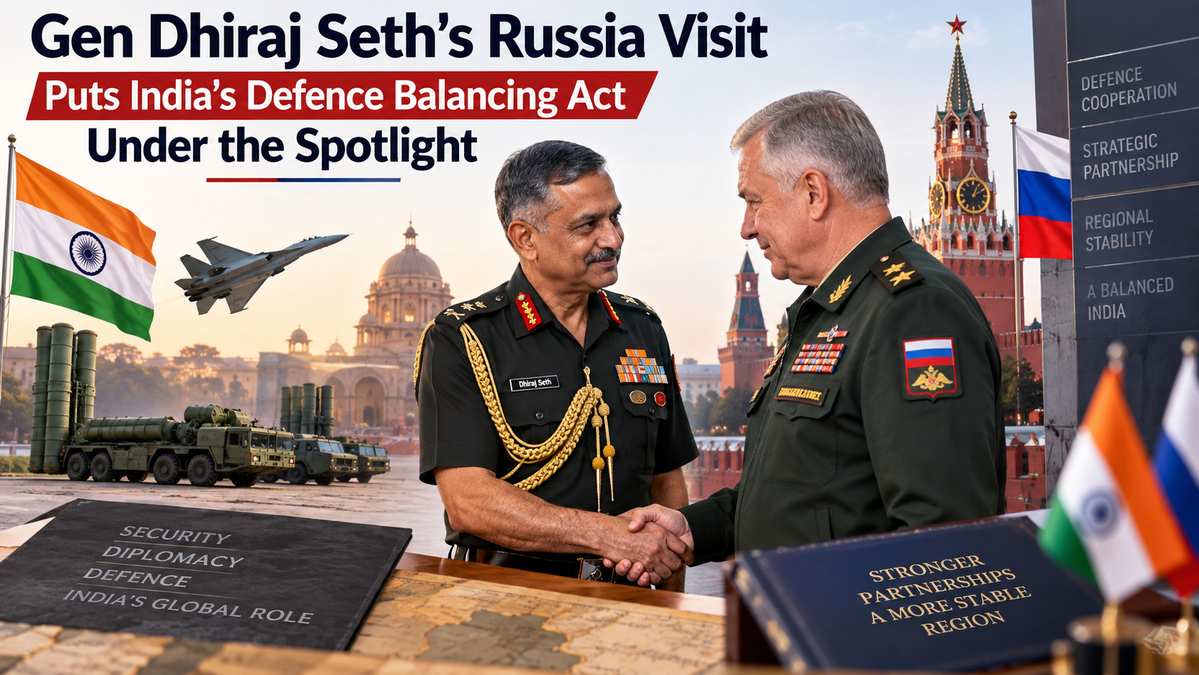
That makes Army chief General Dhiraj Seth’s visit to Russia more than a routine military engagement.
The immediate discussions are expected to cover spare parts, maintenance and upgrades for equipment already in Indian service, while Moscow is also putting forward proposals involving new air-defence systems, infantry fighting vehicles and future battle tanks.
The central question is not whether India will suddenly return to dependence on Russian weapons.
It is how India manages the transition without leaving existing military platforms without the support they still need.
A Moscow Visit With Practical Priorities
General Seth began a three-day official visit to Russia on September 16, according to current reporting.
He is expected to meet Colonel General Andrei Mordvichev, commander-in-chief of Russia’s Land Forces, along with other senior Russian officials. The visit is the first by a serving Indian Army chief to Russia since General Bipin Rawat travelled there in October 2018.
The agenda is expected to include professional military cooperation and training.
But behind the diplomatic meetings lies a more practical concern: keeping India’s existing Russian-origin equipment operational.
That may prove just as important as any new weapons proposal placed on the table.
India Still Has a Huge Russian-Origin Inventory
India has spent decades building its military around equipment supplied or developed in cooperation with Russia and the former Soviet Union.
Tanks, armoured vehicles, air-defence systems, rocket systems and other platforms remain deeply integrated into the Army.
ThePrint reports that Russian-origin equipment is particularly important to the Army’s Armoured Corps and Mechanised Infantry.
This creates a long-term maintenance challenge.
Buying a new platform is only the beginning of a weapon system’s life.
It needs spare parts, ammunition, technical assistance, upgrades and maintenance support for years afterward.
In other words, India’s defence relationship with Moscow is not just about new contracts.
It is also about keeping yesterday’s contracts working today.
Spare Parts May Be the Most Immediate Issue
Among the expected subjects of discussion is the availability of spare parts and supplies for Russian-origin equipment already operated by the Indian Army.
This issue has become particularly important as India attempts to reduce vulnerabilities in foreign supply chains.
For military planners, an aircraft, tank or air-defence system sitting idle because a critical component is unavailable is of limited operational value.
That is why sustainment can sometimes be less glamorous than announcing a new weapon but more immediately important.
India has also been encouraging domestic production of components and defence equipment, meaning the long-term objective is not simply to preserve foreign supply chains indefinitely.
The challenge is managing the transition.
Russia Is Also Offering New Systems
Moscow’s proposals reportedly extend beyond spare parts.
One system in focus is the Pantsir-S1M, an upgraded short-range mobile air-defence platform designed to protect important military assets against threats including aircraft, cruise missiles, drones and precision-guided weapons.
The system is being discussed in the context of the Indian Army’s requirement for a mobile air-defence capability for manoeuvring formations.
But discussion should not be confused with a completed acquisition.
There is no indication from the current reporting that India has finalized a Pantsir-S1M purchase during General Seth’s visit.
That distinction matters because India’s defence procurement process can involve years of evaluation, negotiations, trials and decisions about indigenous content.
The Drone Era Is Changing What Army Air Defence Needs
The interest in mobile air defence also comes at a time when drones have transformed the battlefield.
Modern armies increasingly have to defend troops, command posts and vehicles from a wide range of aerial threats.
A traditional air-defence system designed around aircraft and helicopters may not be sufficient on its own in an environment filled with small drones, loitering munitions and precision weapons.
India’s planned Carrier Air Defence Tracked, or CADET, programme is aimed at providing mobile air defence for Army formations, including in plains, deserts and high-altitude areas.
ThePrint has reported that the Army’s requirement includes substantial indigenous content.
That combination—foreign technology alongside domestic production—is likely to remain a recurring feature of India’s defence modernization.
Then There Is the BMP-3 Question
Russia is also offering India the BMP-3 infantry fighting vehicle as the Army considers the future of its mechanised infantry.
The proposal is particularly interesting because India already operates a large fleet of BMP-2 vehicles and has an indigenous programme aimed at replacing or modernizing that capability.
The Army is pursuing its Future Infantry Combat Vehicle, or FICV, programme.
That creates a strategic choice.
Should India acquire an existing foreign platform relatively quickly?
Or should it invest more heavily in developing an indigenous replacement that could take longer but potentially provide greater domestic control over production and upgrades?
The current reporting does not establish that India has selected the BMP-3.
Rather, it is one of the Russian proposals being discussed.
Why the Battle-Tank Proposal Is Even More Interesting
The tank question is potentially more consequential.
India is working on the Future Ready Combat Vehicle programme, intended to eventually replace ageing T-72 and T-90 fleets with a new-generation main battle tank.
Russia could potentially offer existing technologies or propose some form of joint development and manufacturing arrangement, although the precise Russian proposal remains unclear.
This is where India’s changing defence philosophy becomes particularly visible.
New Delhi has increasingly emphasized indigenous design, production and technology.
A foreign platform could offer an existing technological base.
A joint-development programme could potentially combine foreign expertise with Indian manufacturing and development.
An indigenous system, meanwhile, could offer greater domestic control but requires significant investment and time.
The decision is therefore about more than choosing a tank.
It is about deciding how much of India’s future armoured warfare capability should be developed inside the country.
Russia Remains Important Even as India Diversifies
It would be inaccurate to interpret India’s diversification policy as meaning Russia has suddenly become irrelevant.
The opposite problem exists.
India’s large Russian-origin inventory means Moscow remains important simply because so much equipment is already in service.
At the same time, India has expanded defence cooperation with other countries and placed greater emphasis on domestic manufacturing.
That produces a two-track strategy.
Maintain what already exists while building something different for the future.
General Seth’s visit sits directly in the middle of that transition.
The Ukraine War Has Added Another Layer
Russia’s prolonged war in Ukraine has also changed the international defence environment.
The conflict has demonstrated the importance of drones, electronic warfare, precision weapons, air defence and industrial-scale ammunition production.
For India, that creates questions about how existing Russian equipment performs in modern combat environments and how quickly suppliers can support customers while Russia itself is engaged in a major war.
The issue is not simply whether Russian systems remain useful.
It is whether their supply chains, upgrades and production arrangements fit India’s future military requirements.
India Is Not Starting From Scratch
There is also an important reason why India may continue working with Russia even while diversifying.
Decades of cooperation have created technical familiarity, infrastructure, trained personnel and established maintenance ecosystems.
Replacing an entire military inventory is not like replacing a fleet of commercial vehicles.
A tank operates within a much larger system involving ammunition, repair facilities, training, logistics, spare parts and supporting equipment.
Changing one component can therefore affect many others.
That is why defence diversification tends to happen gradually.
A Recent Contract Shows the Relationship Is Still Active
India’s relationship with Russian defence equipment is not merely historical.
ThePrint reported that India signed a ₹445 crore contract in March for Russian Tunguska air-defence missile systems for the Army.
The contract illustrates the continuing practical relationship even as India pursues indigenous alternatives.
It also highlights an important reality: modernization does not necessarily mean immediately abandoning existing systems.
Older platforms may continue receiving upgrades or support while newer technologies are introduced alongside them.
The Bigger Shift Is From Buyer to Partner
Perhaps the most important development is not any individual weapon discussed in Moscow.
It is the changing model of defence cooperation.
India increasingly wants technology, manufacturing capability and domestic industrial participation rather than simply importing finished equipment.
That makes joint development and local production particularly important.
Russia’s willingness to offer platforms such as the BMP-3 or potentially cooperate on future armoured vehicles will therefore be considered against India’s broader industrial ambitions.
The question becomes:
Can an old defence partnership adapt to India’s new emphasis on self-reliance?
What General Seth’s Visit Can—and Cannot—Tell Us
The visit is significant because it opens discussions across several areas at once: existing equipment, spare parts, air defence, mechanised infantry and future armoured vehicles.
But it would be premature to interpret the visit as evidence that India has already chosen any particular Russian platform.
The current reporting describes proposals and areas of discussion rather than finalized procurement decisions.
That distinction is especially important for the BMP-3, Pantsir-S1M and possible future tank cooperation.
Military diplomacy often starts with conversations long before contracts are signed.
The Real Test Is What Comes After Moscow
General Seth’s Russia visit may therefore be best understood as part of a longer transition.
India needs to keep its existing Russian-origin equipment operational.
It wants more reliable and resilient supply chains.
It is looking for modern air-defence capabilities suited to a battlefield increasingly shaped by drones and precision weapons.
It also wants future armoured platforms to fit its push for domestic manufacturing.
Russia can potentially contribute to several of those objectives.
But so can India’s own defence industry and other international partners.
The challenge is finding the right combination.
India’s Defence Relationship With Russia Is Changing, Not Disappearing
The image of India-Russia defence cooperation is no longer simply one of Moscow supplying weapons and New Delhi buying them.
The relationship is being reshaped by India’s push for self-reliance, the changing character of warfare and the need to maintain decades of existing equipment.
That makes General Dhiraj Seth’s Moscow visit particularly revealing.
The immediate conversation may involve spare parts, air-defence systems, BMP-3 vehicles and future tanks.
The larger conversation is about something much broader:
How does India preserve the advantages of a long-established defence relationship while building a military supply chain that is increasingly designed around domestic production, diversification and future technologies?
The answer will not come from a single visit or one new weapons proposal.
It will emerge through the decisions India makes over the next several years—about what to maintain, what to replace, what to build at home and where foreign technology can still add value.
For now, Moscow remains an important part of that equation.
But India’s defence future is increasingly being shaped by a much wider network of partners—and by the growing capacity of India itself to design and manufacture the weapons its Army will need.