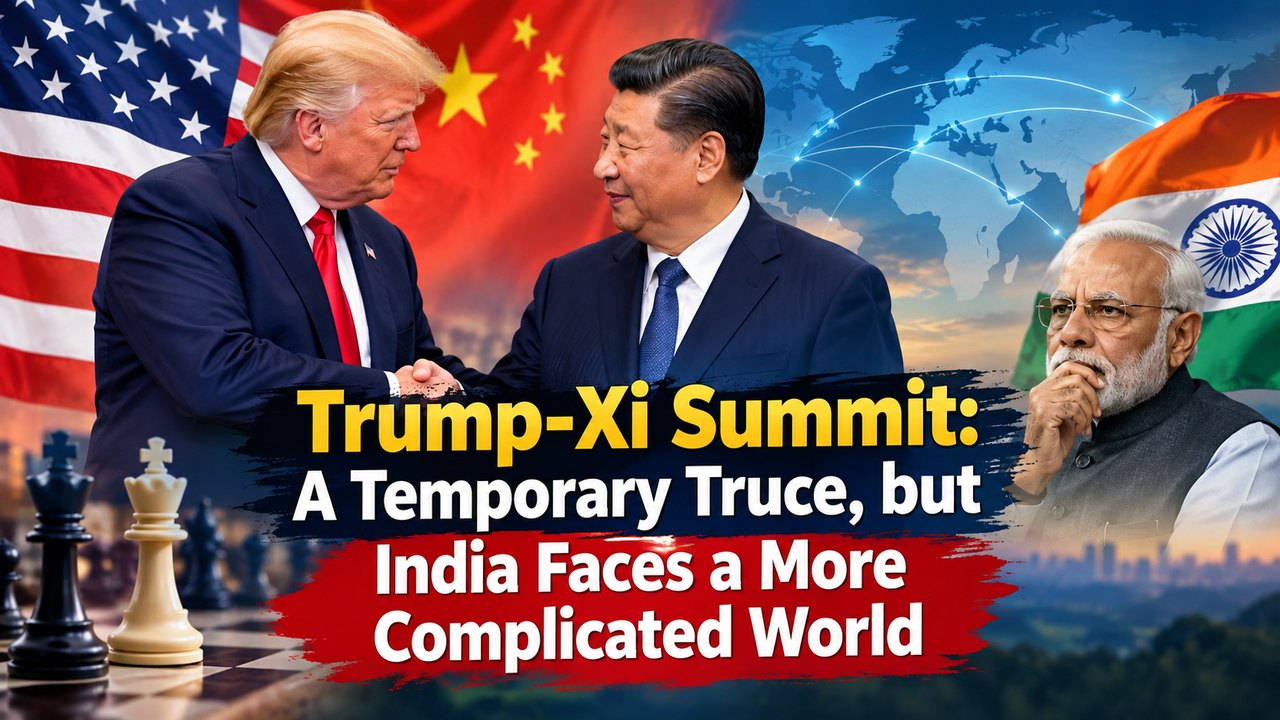
The most important thing about the latest Donald Trump-Xi Jinping summit may be what the two leaders did not settle.
After three days of ceremony, meetings and carefully choreographed diplomacy in Washington, the United States and China emerged with a limited economic understanding but without major breakthroughs on the issues that define their rivalry.
The two sides agreed to extend their existing trade truce by two months, giving negotiators more time to work on tariffs, Chinese purchases of American goods and other economic disputes. But the bigger disagreements — over Taiwan, artificial intelligence, advanced technology, rare earths and China’s relationship with Iran — remain.
For India, that creates a more complicated strategic environment.
New Delhi has benefited from the economic and geopolitical space created by US-China competition. American companies looking to diversify supply chains have explored India as an alternative manufacturing base, while Washington and New Delhi have expanded cooperation in technology and security.
But what happens if Washington and Beijing become better at managing their rivalry?
The answer may matter more to India than whether Trump and Xi simply appear friendly in photographs.
The Summit Produced a Pause, Not a Settlement
The clearest outcome was an extension of the existing US-China trade arrangement.
US Treasury Secretary Scott Bessent said the trade truce, which was due to expire in November, would be extended for another two months. That gives both governments additional time to negotiate rather than immediately returning to a broader tariff confrontation.
For businesses, that temporary stability matters.
Companies can plan around existing tariff conditions for a little longer. Farmers, manufacturers and exporters on both sides gain additional breathing room. Financial markets also avoid the immediate shock of another escalation between the world’s two largest economies.
But a pause is not the same thing as a settlement.
The difficult questions remain on the table, including China’s rare-earth exports, US technology restrictions, agricultural purchases and the broader structure of bilateral trade. Reuters reported that China was meeting its soybean purchasing requirement under the previous arrangement but was behind on its commitment for other US agricultural products.
The trade dispute, in other words, has been postponed rather than permanently solved.
Taiwan Remains the Hardest Strategic Question
If trade provided the summit’s most tangible outcome, Taiwan represented one of its biggest unresolved security issues.
Chinese President Xi Jinping urged Trump to handle the Taiwan issue with what Beijing described as greater prudence and reiterated China’s opposition to Taiwan independence. The Chinese government considers Taiwan part of China and has not ruled out using force to bring the island under its control.
Washington’s publicly stated position did not change at the summit.
The United States has long opposed unilateral changes to the status quo across the Taiwan Strait and is legally required to make defensive equipment available to Taiwan.
That means the summit did not produce a new Taiwan agreement.
And that matters because Taiwan is not simply a regional issue. Any serious crisis around the island could affect semiconductor production, shipping routes, financial markets and global supply chains.
For India, the lesson is straightforward: even when Washington and Beijing are talking, the most dangerous points of disagreement remain unresolved.
AI Was Discussed, But Competition Is Still Intense
Artificial intelligence was another major subject, but the summit did not produce a comprehensive US-China AI agreement.
Both countries recognize that AI is becoming strategically important. It is no longer simply about chatbots or consumer applications. Advanced AI is connected to semiconductors, data centers, military technology, cybersecurity, industrial production and economic competitiveness.
Xi emphasized the need for AI to remain under human control and called for dialogue about its risks and potential misuse.
Washington, meanwhile, has generally emphasized maintaining rapid AI development and America’s technological lead rather than imposing broad new restrictions.
The difference is important.
The two governments can discuss AI safety while simultaneously competing over the chips, computing power and technological capabilities needed to dominate the industry.
That is less like two countries ending a technology race and more like two competitors agreeing that the race needs guardrails.
Rare Earths Remain a Source of Leverage
One of the less dramatic but economically important issues is rare earths.
Modern industries depend on rare-earth materials for products ranging from electronics and electric vehicles to advanced industrial and defense systems. China has significant influence over global rare-earth processing and refining.
That gives Beijing an economic tool that Washington cannot easily ignore.
The US, meanwhile, has increasingly used export controls and technology restrictions to limit China’s access to certain advanced technologies, particularly sophisticated semiconductor capabilities.
The result is a strange economic relationship.
The two countries are still deeply connected through trade, yet both are simultaneously trying to reduce strategic dependence on the other.
The summit did not remove that contradiction. Instead, it gave negotiators additional time to manage it.
Iran Added Another Layer to the Relationship
The US-China relationship is also being shaped by conflicts outside East Asia.
The Iran war has become another point of disagreement between Washington and Beijing. Xi has called for the United States and Iran to resolve their differences through negotiations.
China’s relationship with Iran matters because Beijing is an important economic partner for Tehran, including through energy trade.
For Washington, however, pressure on Iran is part of a much wider geopolitical strategy.
For China, preventing instability that threatens energy supplies and regional trade is also important.
The two countries therefore have different interests but one shared concern: a conflict that expands beyond control could damage both economies.
That creates an unusual situation in which Washington and Beijing can compete intensely while still having reasons to communicate.
Why India Should Pay Attention
This is where the summit becomes particularly important for India.
For years, one assumption in New Delhi has been that stronger US-China rivalry can create opportunities for India.
As American companies seek alternatives to Chinese manufacturing, India has promoted itself as a major destination for investment. The strategic competition between Washington and Beijing has also strengthened India’s importance in the Indo-Pacific.
But a US-China relationship that becomes more stable without becoming genuinely friendly could change the calculation.
The two countries do not need to become allies for India to face a different strategic environment. They only need to become better at managing disagreements.
Think of it as two large ships sailing in the same narrow channel. They do not have to like each other. They simply need to become better at avoiding a collision.
That is potentially more important for India than the smiles at the White House.
The Russian Oil Problem Is More Immediate
India’s most immediate concern is arguably not Taiwan or AI but energy.
The United States now has new legal authority to impose tariffs of up to 100% on countries that purchase Russian energy. The legislation gives President Trump significant discretion; it does not automatically impose a 100% tariff on India.
That distinction is important.
India remains a major buyer of Russian crude because the supplies have helped its refiners secure competitively priced energy. Reuters reported that Russian oil accounted for more than 40% of India’s crude supplies at one point, although India’s Russian imports had already fallen in August and were expected to decline further in September.
The Trump-Xi summit did not solve this problem for India.
In fact, China’s position makes the issue even more complicated. China is also a major buyer of Russian energy, meaning Washington’s pressure on Russian oil is not exclusively an India problem.
If the United States ultimately uses its new tariff authority against major Russian-oil buyers, both Asian powers could face difficult choices.
India Has More Than One Option
That does not mean India is powerless.
Indian refiners have already been diversifying their crude purchases. Reuters reported that supplies from the Middle East were increasing as Russian purchases declined, while Indian companies were also turning to spot markets for future supplies.
India can therefore adjust its energy mix.
But every adjustment has a price.
Alternative crude may be more expensive. Shipping routes may be longer. Insurance costs can change. Refinery configurations also matter because different refineries are designed to process particular grades of crude efficiently.
So replacing Russian oil is not simply a matter of finding another seller.
It is an economic calculation involving fuel prices, inflation, trade balances and India’s wider relationship with Washington and Moscow.
China Could Become More Important to India’s Strategy
The summit also highlights another reality: India cannot treat its relationship with the United States independently of its relationship with China.
China remains India’s largest economic competitor in many manufacturing sectors and a major source of imports. At the same time, India and China are members of BRICS and remain important players in the wider Asian economy.
New Delhi therefore faces a balancing act.
It wants stronger cooperation with Washington without becoming completely dependent on the United States. It wants economic engagement with China while reducing vulnerabilities created by excessive dependence on Chinese supply chains. And it wants to preserve its longstanding relationship with Russia while avoiding secondary economic consequences from US sanctions policy.
That is not a simple three-way choice.
It is a constantly changing equation.
The Real Outcome: Managed Rivalry
The Trump-Xi summit should therefore not be judged only by the number of agreements signed.
Its deeper significance lies in the possibility that Washington and Beijing are developing a model of managed competition.
They can disagree over Taiwan, compete over AI, fight over tariffs and restrict technology while still maintaining enough communication to prevent every disagreement from becoming a crisis.
That may make the global economy more predictable in the short term.
But it does not remove the underlying rivalry.
For India, that is the central takeaway.
A US-China trade war could create opportunities for Indian exporters. A sudden US-China reconciliation could reduce some of those opportunities. A prolonged rivalry could continue pushing supply chains toward India while also increasing pressure on New Delhi to take positions on technology, Russia and security.
The Trump-Xi summit has not decided which of those futures will emerge.
Instead, it has bought Washington and Beijing more time.
And for India, that may be the most important development of all: the world’s two largest powers are not ending their rivalry — they are learning how to manage it.