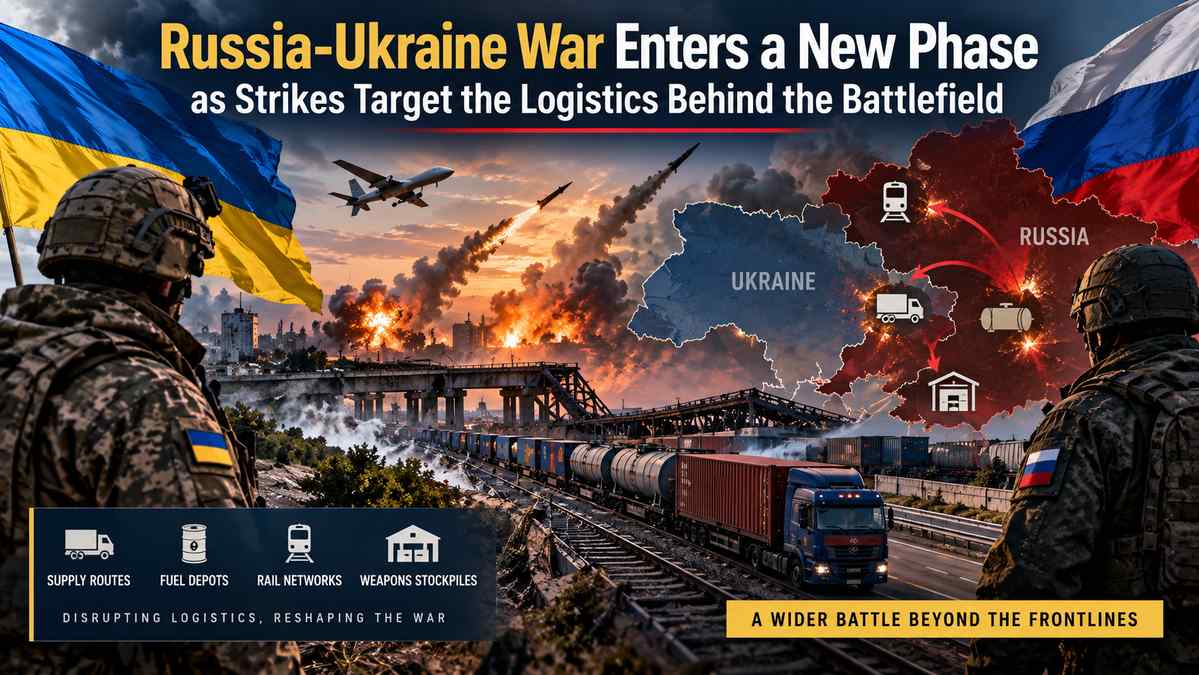
The Russia-Ukraine war is increasingly becoming a contest not just over territory, but over the systems that keep armies supplied, armed and moving.
Recent Russian strikes have reportedly targeted Ukrainian military-linked infrastructure, including logistics and cargo facilities, while Moscow has claimed heavy Ukrainian battlefield losses. At the same time, Ukraine continues to use long-range weapons against Russian military and industrial targets.
The result is a war in which the destruction of a warehouse, refinery, transport hub or supply route can matter almost as much as the capture of a position on the front.
One widely circulated figure claims that more than 1,200 Ukrainian personnel were killed in recent fighting. That number should be treated as a Russian battlefield claim rather than an independently verified total. Ukraine and Russia routinely publish very different assessments of casualties, and independent verification of daily battlefield losses is extremely difficult.
The more significant development may be elsewhere: the expanding battle over logistics.
The Battlefield Is No Longer Just the Front Line
For much of the war, attention has naturally focused on places such as Donetsk, Sumy, Kharkiv and other areas close to the front.
But modern warfare rarely ends where the trenches end.
A military unit needs ammunition, fuel, spare parts, food, replacement equipment and personnel. Those supplies have to travel through a network of roads, railways, warehouses, ports and distribution centers.
Destroying one part of that network can create problems much farther away.
That is why long-range strikes have become such an important part of the conflict.
The objective is not always to destroy a large concentration of troops. Sometimes it is to make it harder for those troops to receive what they need.
Russia Says It Hit Military Cargo Infrastructure
Russian authorities have reported strikes on Ukrainian facilities that Moscow says were handling military cargo.
Earlier reporting described Russian attacks on Ukrainian port infrastructure at Chornomorsk and Izmail, with Moscow saying military cargo was present at one of the targeted locations. Those claims were reported by Interfax citing Russia’s Defence Ministry.
The distinction is important.
A Russian claim that a facility contained military cargo does not independently establish exactly what was destroyed or how much military equipment was present.
But the broader pattern is clear: Ukrainian ports and transport infrastructure remain strategically important because they connect the country’s military and economic networks to international supply routes.
Why Logistics Can Change the War
Think of a modern army as a giant machine.
The soldiers are visible.
The tanks and artillery are visible.
But behind them is an enormous supply chain.
Remove enough fuel and vehicles slow down.
Disrupt ammunition deliveries and artillery activity can decline.
Damage repair facilities and damaged equipment stays out of action longer.
Strike transport hubs and supplies may have to travel through longer or more dangerous routes.
This is why military planners have increasingly focused on logistics as a target.
The goal is not necessarily to win one battle overnight.
It is to make the enemy’s entire military system less efficient.
Ukraine Is Using the Same Strategy Inside Russia
The strategy works in both directions.
Ukraine has increasingly conducted long-range strikes against Russian oil refineries, fuel facilities, military factories, logistics sites and other infrastructure connected to the war effort.
The Institute for the Study of War has documented Ukrainian strikes against Russian military assets as well as logistics facilities operated by major Russian commercial networks.
In one recent example, Ukrainian officials said their forces struck Russian oil-processing facilities and other targets connected to Russia’s military infrastructure.
These attacks have become particularly important because Russia’s large industrial base allows Moscow to sustain prolonged military operations.
Ukraine therefore faces a strategic problem: it must try to impose costs on that industrial system from a considerable distance.
Russia’s Refinery Problem Shows Why Infrastructure Matters
The impact of Ukraine’s long-range campaign is not limited to military targets.
Russia’s energy infrastructure has also come under pressure.
Reuters reported that six major Russian diesel-producing refineries had suffered significant production cuts or complete stoppages in September because of damage caused by drone attacks. The affected facilities represented roughly half of Russia’s major diesel-refining capacity.
That matters because fuel is the bloodstream of a modern military.
Armored vehicles need diesel.
Military trucks need fuel.
Aircraft and ships require energy.
Even civilian fuel shortages can create economic pressure that eventually affects a country’s ability to sustain a war.
Casualty Figures Need to Be Read Carefully
The “1,200 killed” figure in the headline is dramatic, but battlefield casualty statistics are among the hardest claims to independently verify.
Russia regularly publishes figures for Ukrainian losses.
Ukraine does the same for Russian losses.
Neither side provides a neutral daily accounting of casualties, and independent organizations generally cannot verify every reported battlefield death in real time.
Recent Ukrainian estimates have also claimed large Russian losses. Ukraine’s General Staff, for example, recently reported roughly 1,700 Russian military personnel losses over a 24-hour period. Those figures are Ukrainian estimates, not independently confirmed totals.
That is why responsible reporting should distinguish between a government’s battlefield claim and a verified casualty count.
The underlying fact that the fighting remains extremely costly is much easier to establish than any single daily number.
Russia Is Still Generating New Forces
Despite enormous losses reported by both sides, Russia continues to recruit personnel.
The Institute for the Study of War reported that Russian authorities were recruiting approximately 1,000 to 1,200 people per day, while Ukrainian General Staff data indicated average Russian casualties of about 1,374 per day since the beginning of July.
These figures come from different sources and should not be treated as a precise mathematical balance sheet.
Still, they illustrate the central challenge facing Moscow: maintaining the size and tempo of its military operations while replacing battlefield losses.
That makes recruitment, training and logistics equally important.
Ukraine Faces a Different Problem
Ukraine’s challenge is not simply manpower.
It also needs weapons, ammunition and air-defense systems from its international partners.
Those supplies have to enter Ukraine and then move toward units operating near the front.
This makes transportation infrastructure strategically important.
A strike against a logistics node can potentially affect the battlefield without ever hitting a trench.
That is one reason ports, railway links, warehouses and transport facilities have become increasingly significant in the conflict.
The War Is Becoming a Contest of Distance
One of the biggest changes in the conflict has been the increasing ability of both sides to strike targets far beyond the immediate battlefield.
Drones can travel hundreds of kilometers.
Long-range missiles can reach important infrastructure deep inside opposing territory.
This has changed the geography of the war.
A factory far from the front is no longer automatically safe.
Neither is a fuel depot, railway facility or logistics warehouse.
The rear area has effectively become another battlefield.
Drones Are Making Deep Strikes Cheaper
There is also an economic dimension to this transformation.
Using a highly expensive missile against a relatively inexpensive target is difficult to sustain indefinitely.
Drones can provide a cheaper way to attack large and dispersed infrastructure networks.
Russia has expanded its use of drones and missiles against Ukrainian targets, while Ukraine has increasingly developed long-range drone capabilities for attacks inside Russia.
The result is a competition over not only weapons technology but also cost per strike.
Who can destroy more with fewer resources?
That question may become increasingly important as the war continues.
Energy Infrastructure Has Become a Strategic Weapon
The growing importance of logistics is closely connected to energy.
Fuel allows military vehicles to move.
Electricity keeps factories operating.
Refineries produce the fuel needed by civilian and military transportation.
Ports move supplies and commodities.
This creates a chain reaction.
A strike against one part of the system can affect several others.
Recent attacks on Russian refineries and continuing Russian strikes against Ukrainian energy infrastructure show how both sides are trying to pressure the other’s economic and industrial capacity.
A Battle of Attrition Beyond the Trenches
The war is therefore increasingly looking like a battle of attrition conducted across multiple layers.
There is the traditional fight for territory.
Then there is the air war.
There are drone campaigns.
There are attacks on energy facilities.
There are strikes against manufacturing and logistics.
And there is the constant effort to replace lost personnel and equipment.
The side that can maintain this system for longer may gain an important advantage, although battlefield outcomes remain dependent on many variables.
Why the Cargo Network Matters
Military cargo is not simply a collection of boxes moving from one location to another.
It represents the physical connection between international support, domestic production and frontline operations.
A weapon must first be manufactured or supplied.
It must then be transported.
It may need storage.
Eventually, it has to reach the unit that will use it.
Breaking any link in that chain can create delays.
This is why the reported targeting of military-linked cargo infrastructure is more significant than the destruction of a single facility might initially suggest.
Russia’s Strategy Is Also Under Pressure
Moscow continues to possess considerable military resources, but sustaining a prolonged war requires more than having weapons available.
Russia must maintain production, recruit personnel, repair equipment and keep fuel moving.
Ukraine’s long-range campaign is designed in part to make those tasks more difficult.
The same principle applies to Russian strikes against Ukraine.
Moscow has repeatedly targeted infrastructure that supports Ukraine’s military and economy.
The war is therefore becoming increasingly focused on the ability of each country to keep its entire system functioning.
The Front Line May Not Tell the Whole Story
Maps showing territorial changes can sometimes obscure what is happening underneath.
A frontline may move only a few kilometers while enormous amounts of equipment and ammunition are being consumed.
A refinery can be damaged hundreds of kilometers away.
A logistics center can be destroyed far from the trenches.
A drone factory can be targeted deep inside enemy territory.
These actions may not immediately change the map, but they can influence what becomes possible on the battlefield weeks or months later.
The Bigger Question Is Sustainability
That leads to the most important question surrounding the latest escalation:
How long can each side sustain this level of warfare?
Russia has a larger industrial base and continues recruiting thousands of personnel.
Ukraine has demonstrated an expanding ability to conduct long-range strikes and remains dependent on international military assistance for significant parts of its defense.
Both sides are adapting.
Both are trying to make the other’s war machine more expensive to operate.
And both are looking beyond the next battlefield engagement.
This Is More Than Another Night of Strikes
The latest reports should therefore not be viewed simply as another exchange of missiles and drones.
They point toward a deeper evolution in the conflict.
Russia is trying to damage Ukraine’s military supply system.
Ukraine is increasingly reaching deep into Russia’s industrial and energy infrastructure.
Both sides are attempting to disrupt the machinery behind the front line.
The reported figure of more than 1,200 Ukrainian personnel killed may dominate attention, but without independent verification it should remain clearly identified as a battlefield claim.
The broader and more verifiable story is the growing importance of logistics.
In a war where neither side has achieved a decisive breakthrough, the ability to keep supplying the battlefield may become as important as the ability to capture territory.
The next phase of the Russia-Ukraine war may therefore be decided not only by what happens in the trenches, but by what happens behind them—inside factories, ports, refineries, warehouses, rail networks and supply corridors.
And that makes every strike on the logistics network potentially part of a much larger battle over who can keep the war machine running.