
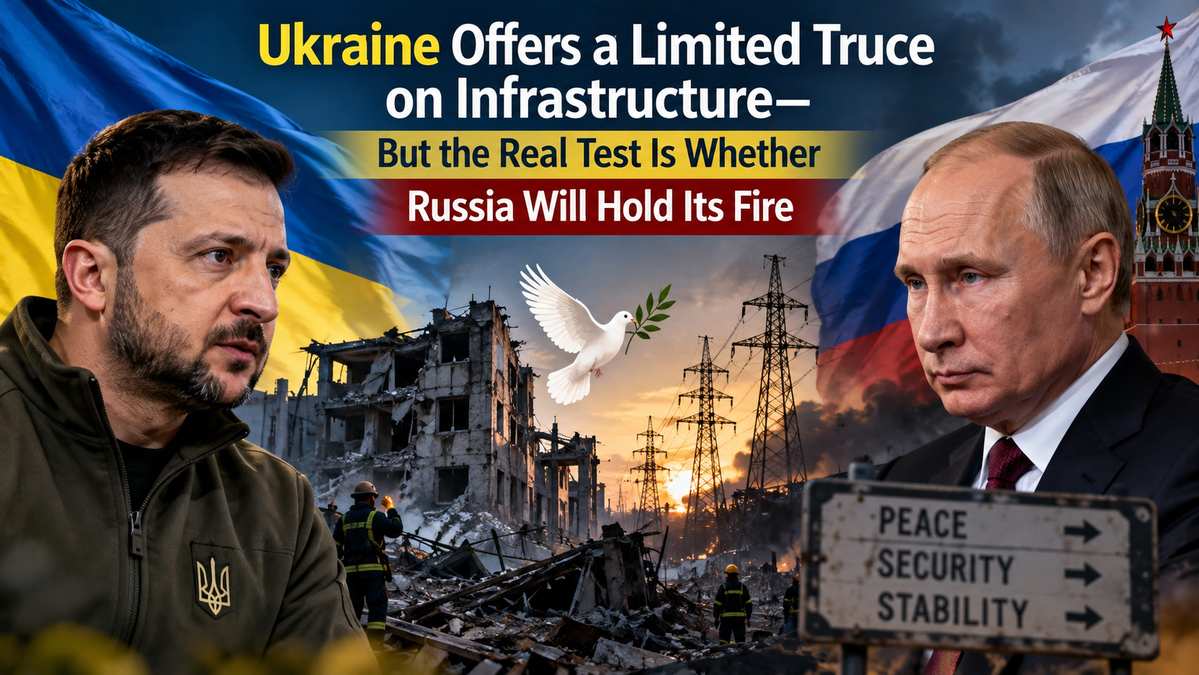
A possible opening for de-escalation has emerged in the Russia-Ukraine war, but it comes with a major condition.
Ukraine says it is prepared to stop striking critical infrastructure inside Russia if Moscow makes a genuine and lasting commitment to stop attacking Ukrainian infrastructure.
That is not the same thing as a broad ceasefire.
And, despite U.S. President Donald Trump’s claim that Russia and Ukraine had already agreed to stop targeting each other’s energy facilities, Kyiv says the details still need to be secured.
The distinction matters.
After more than four years of full-scale war, even a narrow agreement protecting electricity networks, energy facilities and essential supply routes could have meaningful consequences for civilians.
But it would also require something that has repeatedly proved difficult during the conflict: confidence that the other side will actually honor the arrangement.
Zelenskyy Puts a Condition on Ukraine’s Participation
Ukrainian President Volodymyr Zelenskyy said Kyiv was ready to halt its attacks on Russian territory if Ukraine’s international partners could ensure that Russia would stop striking Ukrainian electricity systems, energy facilities, critical infrastructure and food-supply routes.
He emphasized that any arrangement would need to be reliable and long-lasting rather than a temporary pause.
That position effectively turns the proposed infrastructure truce into a conditional exchange:
Russia stops attacking essential Ukrainian infrastructure, and Ukraine stops corresponding attacks on Russian infrastructure.
For Kyiv, the value would be immediate protection of systems that affect daily life.
For Moscow, it could reduce attacks on energy facilities that have increasingly affected Russia’s fuel production and domestic supply.
Trump Says an Agreement Already Exists
The uncertainty became more pronounced after Trump said Russia and Ukraine had agreed not to strike each other’s energy targets.
Trump wrote that Ukraine had agreed not to attack Russian energy infrastructure and that Russia had agreed to do the same.
But Zelenskyy’s response indicated that Kyiv viewed the matter differently.
Rather than describing a completed agreement, he said Ukraine had proposed that its partners secure a Russian commitment and that Kyiv was ready to reciprocate if Moscow demonstrated a genuine willingness to comply. Reuters characterized Zelenskyy’s statement as appearing to contradict the suggestion that Ukraine had formally endorsed Trump’s version of events.
So the immediate story is not a confirmed energy ceasefire.
It is a proposal that still needs agreement, guarantees and implementation.
Why Infrastructure Has Become a Battlefield
Energy infrastructure has become one of the most important pressure points in the war.
Russia has repeatedly attacked Ukrainian energy facilities, while Ukraine has increasingly used long-range drones against Russian refineries and other energy-related targets.
For civilians, the consequences are obvious.
Damage to power infrastructure can mean electricity shortages, disrupted heating and problems with water systems.
For Russia, attacks on refineries can create a different kind of pressure by reducing fuel production.
That pressure has become increasingly visible in Russia’s domestic diesel market.
Reuters reported that drone attacks had disrupted operations at six major Russian diesel-producing refineries, together accounting for roughly half of the country’s diesel production capacity. The disruptions contributed to fuel shortages and prompted Moscow to restrict exports.
This helps explain why infrastructure has become a potential bargaining point.
It affects both sides.
Ukraine Has Its Own Reasons to Consider a Pause
Kyiv’s willingness to consider such an arrangement does not necessarily mean Ukraine is abandoning its strategy of striking Russian military or economic targets.
Instead, it could represent a tactical distinction between infrastructure that supports ordinary civilian life and other targets associated with Russia’s war effort.
Zelenskyy has argued that energy facilities, ports, logistics networks and food-related infrastructure should be protected.
The potential agreement would therefore be narrower than a general halt to military operations.
Fighting along the front could continue.
Military targets could remain contested.
Long-range attacks unrelated to critical infrastructure could continue.
That is why calling the proposal a full ceasefire would overstate what has actually been discussed.
The Timing Is Particularly Important
The proposal comes as both sides face different forms of pressure.
Ukraine is approaching another difficult winter while continuing to protect its energy network from Russian attacks.
Russia, meanwhile, is dealing with the economic consequences of Ukrainian strikes on refineries and fuel infrastructure.
The two pressures create a rare area where their immediate interests overlap.
Neither side necessarily needs to agree on the wider war to recognize the practical cost of continued attacks on critical infrastructure.
That is what makes an infrastructure-focused arrangement potentially more achievable than a comprehensive ceasefire.
But “potentially” is doing a lot of work here.
Russia Has Welcomed the Idea—With Conditions
The Kremlin has responded positively to Trump’s proposal in principle.
Reuters reported that Kremlin spokesperson Dmitry Peskov welcomed the idea of a mutual moratorium but raised additional issues, including the safety of commercial shipping and sanctions affecting Russia.
That suggests Moscow may see an infrastructure truce as part of a wider negotiation rather than an isolated arrangement.
This could make the diplomatic process more complicated.
If one side wants a narrow agreement on energy targets while the other attaches additional economic or maritime demands, reaching a mutually acceptable package becomes harder.
The Problem of Trust Remains
Perhaps the biggest obstacle is not technical.
It is trust.
Ukraine has explicitly said it is not convinced that Russia would comply with an agreement.
That concern is understandable in the context of a war in which previous ceasefire and negotiation efforts have repeatedly failed to produce a durable settlement.
Zelenskyy has therefore stressed that any infrastructure arrangement should be long-term and produce a real effect on people’s lives.
That raises a practical question:
Who would determine whether the agreement had been violated?
Would a damaged power plant count?
What about a refinery supplying fuel to the military?
Would attacks on railway infrastructure qualify?
What if a missile aimed at a military facility damages a nearby civilian energy installation?
These questions would need answers before a meaningful agreement could operate.
Verification Could Be More Important Than the Announcement
A truce can be announced in a few sentences.
Monitoring it is much harder.
Any agreement would need some mechanism for identifying attacks, determining responsibility and communicating violations.
Without such a system, each side could accuse the other of breaking the arrangement while insisting that its own actions were defensive or accidental.
The experience of the wider war demonstrates how quickly such disputes can undermine fragile diplomatic openings.
That makes verification one of the most important parts of any infrastructure agreement.
The Economic Stakes Extend Beyond Russia and Ukraine
The infrastructure conflict is also affecting people far beyond the battlefield.
Russia’s reduced refinery output has contributed to tighter fuel supplies, while the broader war has added pressure to already strained global energy markets.
Reuters reported that Russia’s refinery disruptions contributed to restrictions on fuel exports as Moscow sought to stabilize domestic supplies.
The consequences can therefore reach international consumers through diesel, transportation and shipping costs.
That helps explain Trump’s interest in the issue.
An infrastructure truce could potentially reduce some of the pressure on fuel markets if it results in fewer attacks on energy facilities.
But global fuel prices are influenced by many factors, so an agreement between Moscow and Kyiv would not by itself determine the direction of energy markets.
This Is Not Yet a Peace Deal
It is important not to confuse an infrastructure arrangement with negotiations over the war itself.
Even if Russia and Ukraine stop attacking selected energy and civilian infrastructure, fundamental disagreements would remain.
Territorial control, security guarantees, military arrangements and the future political relationship between the two countries would still need to be addressed.
The proposed pause would therefore be better understood as a limited confidence-building measure.
Its importance would come from what it could demonstrate.
If both sides could successfully maintain a narrow agreement, it might provide evidence that limited cooperation is possible even while the wider conflict continues.
If the agreement quickly collapsed, it would reinforce the argument that broader arrangements require much stronger guarantees.
Ukraine Wants More Than a Temporary Pause
Zelenskyy has been careful to emphasize duration.
Kyiv does not appear to want a short arrangement that simply gives both sides time to replenish supplies or prepare for another round of attacks.
He has argued that infrastructure protection should have a lasting effect on people’s lives.
That demand reflects a central problem with temporary wartime pauses.
A few quiet days can provide relief.
But rebuilding damaged infrastructure requires months or years.
Energy companies need time to repair facilities.
Power networks need replacement equipment.
Communities need confidence that repaired infrastructure will not immediately become a target again.
For that reason, predictability may be almost as important as the initial ceasefire itself.
Russia and Ukraine Are Fighting an Economic War as Well
The infrastructure issue also reveals how modern warfare extends beyond the battlefield.
Ukraine’s attacks on Russian refineries are intended to create economic and logistical pressure.
Russia’s attacks on Ukrainian energy systems have sought to damage infrastructure that supports civilian life and the broader economy.
The two strategies operate differently, but both demonstrate the importance of industrial capacity.
Fuel production, electricity generation, ports, railways and supply networks can influence a war even when they are hundreds of kilometers from the front.
That makes protecting infrastructure increasingly central to both military planning and diplomacy.
A Narrow Deal Could Still Matter
There is a temptation to judge a proposed truce only by whether it ends the war.
That would miss its immediate significance.
If an agreement genuinely protected Ukrainian electricity infrastructure and Russian energy facilities, it could reduce damage without requiring either side to resolve every underlying disagreement.
For civilians, that could mean fewer power disruptions.
For Russia, it could mean less pressure on fuel production.
For international markets, it could potentially reduce one source of uncertainty.
But those benefits depend entirely on implementation.
A promise that exists only on paper would have limited value.
The Next Step Is Not Another Speech
The immediate challenge is turning broad statements into specific commitments.
What infrastructure is protected?
How is a violation defined?
Who investigates an incident?
How quickly can allegations be addressed?
How long does the arrangement last?
What happens after a violation?
And most importantly, can both governments demonstrate that they will follow the same rules?
Those details will determine whether the proposal becomes a genuine de-escalation measure or another short-lived diplomatic initiative.
The Bigger Significance of Zelenskyy’s Offer
Zelenskyy’s statement represents a notable shift in the conversation because Ukraine is explicitly linking its own long-range strikes to a reciprocal Russian commitment to protect infrastructure.
But the statement should not be mistaken for a completed agreement.
As of September 15, Trump had publicly described an understanding between Russia and Ukraine, while Zelenskyy was still calling for partners to secure a credible Russian commitment and asking for concrete proposals.
That gap between political announcements and operational agreements may be the most important part of the story.
A ceasefire does not begin when leaders describe it.
It begins when weapons stop being used under agreed rules—and continue to stay silent.
What Comes Next?
The proposed infrastructure truce offers a limited but potentially meaningful route toward reducing some of the war’s most damaging effects.
Ukraine wants protection for electricity, energy facilities, logistics and food-supply routes.
Russia has an interest in reducing attacks that have disrupted its refining sector and fuel supplies.
The United States is pushing the issue partly because the conflict is increasingly affecting global energy markets.
But all three interests still have to overcome the central obstacle: mistrust.
For now, the most accurate description is not that Russia and Ukraine have reached a confirmed infrastructure ceasefire.
It is that Ukraine says it is prepared to stop corresponding strikes if its partners can secure a genuine Russian commitment to stop attacks on critical infrastructure.
That may sound like a small opening in a war that has become enormously complicated.
But diplomacy often begins exactly there—not with agreement on everything, but with finding one area where both sides have a reason to stop making the situation worse.
The real test will be whether Moscow and Kyiv can turn that narrow opening into something that survives the first serious dispute.